
Thriving Kids and the NDIS: What Thriving Kids Means for Your Child's Continence Support


Article by Monica Reeves (B.Nurs, GradCert Autism) - Autism & Continence Specialist, Founder of Brightlives
Over the past few weeks, families navigating the NDIS Thriving Kids program have been asking us the same question again and again: Will my child lose their NDIS funding, and what happens to our continence assessment and toileting supports?
These are fair questions. Thriving Kids started on 1 October 2026, and there's been a lot of noise around it. Some of it is accurate, some of it isn't, and much of it leaves families more worried than when they started reading.
So let's slow it down. This article explains what Thriving Kids is, what's changing and when, and why continence deserves a clear place in the conversation for young autistic children and children with developmental delay.
What is Thriving Kids?
Thriving Kids is a new program by the Australian Federal Government for children aged 8 and under with developmental delay or autism who have low to moderate support needs. It sits outside the NDIS. The Australian Federal Government describes it as a foundational support, meaning support that families can access in the community without needing an NDIS plan.
The program is jointly funded by the Australian Government and the states and territories, with $4 billion committed over five years. Families don't pay to use it, and a child doesn't need a diagnosis to access support.
What does that support actually look like? Over time, Thriving Kids is expected to offer three broad layers:
Information and advice for families, available to anyone. This is available through the Thriving Kids National Digital Information Hub.
Help to identify developmental needs early, including a new developmental check for three-year-olds
Programs and targeted supports, including allied health services such as speech pathology and occupational therapy
The first layer is already here. The others are being built over the next 15 months.
What's changing with Thriving Kids, and when?
The most important thing to know is that nothing changes for children already on the NDIS right now. Children who currently have an NDIS plan can keep using it under the existing arrangements until 1 January 2028. The two systems run side by side until then. (See bottom of Blog for the exact timeline published by the Australian Federal Government).
When | What happens |
1 October 2026 | General supports begin: the Thriving Kids online hub (run by Raising Children Network), a national phone line on 1800 882 436 and a new Autism Helpline on 1300 654 789 |
From 1 November 2026 | A Medicare-subsidised developmental health check for three-year-olds becomes available |
During 2027 | Allied health and therapy supports start rolling out, with timing that varies from state to state |
1 January 2028 | Thriving Kids is expected to be fully rolled out, and NDIS access changes take effect |
From 2028, children with low to moderate support needs are expected to receive support through Thriving Kids rather than the NDIS. Children with significant and permanent disability, or higher support needs, will continue to be eligible for the NDIS under the usual criteria.
What we don't know yet about Thriving Kids:
It's worth being honest about the gaps. The government hasn't yet clearly defined what "low to moderate support needs" means, and advocacy groups have raised this as a major concern. Each state and territory is rolling out its own version, and at the time of writing Queensland had not yet signed on.
What this means in practice is that families are making decisions in a system that is still being built. That's uncomfortable. It's also why getting a clear, written picture of your child's needs now is so valuable.
Why Continence Support Belongs in the NDIS Thriving Kids Discussion:
Most of the public discussion about Thriving Kids has focused on speech, language and behaviour support. Continence rarely gets a mention. Yet for many families of young autistic children, toileting is one of the biggest daily pressures in the house.
Research consistently shows that autistic children experience wetting, soiling and constipation more often than other children, and often for longer. That isn't because they're not trying, and it isn't because parents haven't done enough.
Autism and Continence: Why Toileting is More Than Just Habit Training
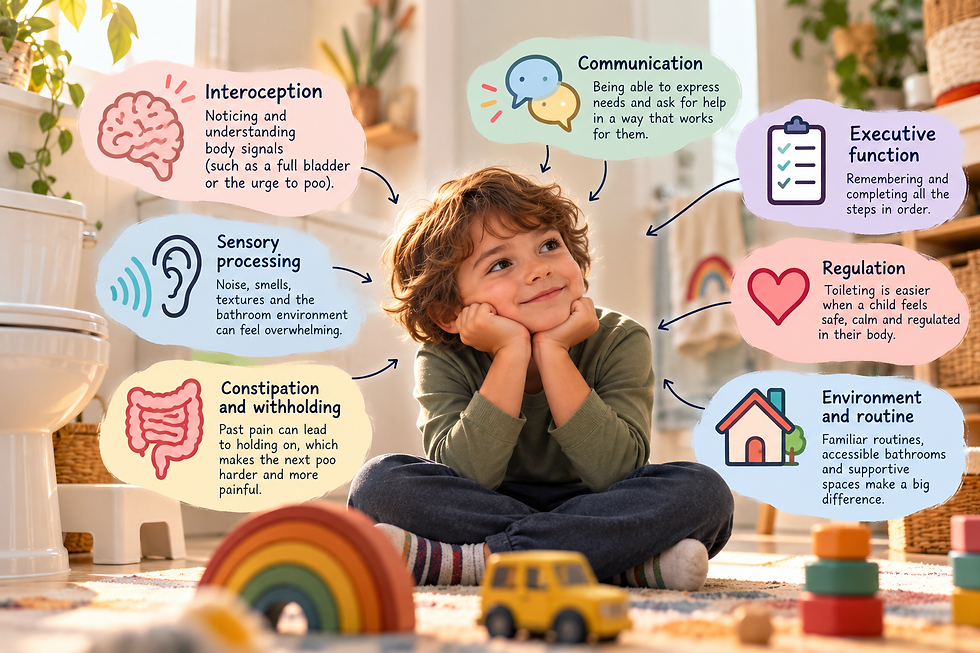
When we look at continence through a functional lens, we're looking at far more than whether a child can sit on the toilet. Several things are often happening underneath:
Interoception, meaning the ability to notice and understand signals from inside the body, such as a full bladder or the urge to poo
Sensory processing, meaning how a child experiences the noise of a flush, the feel of a cold seat, the smell of a bathroom or the sensation of wiping
Constipation and withholding, where a past painful poo leads a child to hold on, which makes the next one harder and more painful
And then we add the layers of communication, routine, executive function (meaning the ability to plan and complete all the steps in order) and simply how regulated a child feels in that moment.
Let's think of it like a phone sitting on silent. The message from the bladder is being sent. The phone receives it. But the child doesn't hear it until it's far too late to respond. From the outside, it can look like a child is ignoring the toilet or refusing to go. Most of the time, the signal just isn't being heard.
Why Continence matters for Thriving Kids
Continence affects so much more than toileting. It shapes whether a child can attend preschool or school comfortably, join in at sport, sleep over at a grandparent's house, or go on an outing without the whole family planning around bathroom access.
This is why continence needs to be understood and documented properly, rather than being written off as something a child will "grow out of". When a child's needs are being considered, whether in an NDIS plan now or a Thriving Kids pathway later, continence is part of the picture of daily functioning.
What families can do now
None of this needs to be rushed, but there are a few practical steps that can make the next 15 months much smoother.

1. Keep a simple record
A bladder and bowel diary over a week or two tells a much clearer story than memory ever can. Note when your child drinks, when they wee or poo, any accidents, what their poo looks like, and anything that seems to make things harder, such as a busy day, a new place or feeling unwell.
2. Make sure continence is written down, not just mentioned
If your child is on the NDIS, it's worth checking that continence appears in their plan goals and in their therapy reports, with a clear description of how it affects daily life. If it's only been talked about in passing, it may not be visible to anyone making decisions later.
You might say to your support coordinator or therapist, "Toileting is a big part of our day. Can we make sure it's included in the next report?"
3. Ask the right questions about future support
If you're told your child may move to Thriving Kids, it's reasonable to ask how continence support will be provided, who will provide it, and what happens with continence products. These answers aren't always available yet, and that's okay. Asking early means the gap is noticed.
A note on continence products
Some families may be eligible for the Continence Aids Payment Scheme (CAPS), a government payment that helps with the cost of continence products. It's available from age 5 for people with permanent and severe incontinence linked to an eligible condition. People whose NDIS plan already includes continence support can't receive CAPS at the same time. Eligibility depends on individual circumstances, so it's best to check directly with Services Australia.
For support coordinators and clinicians
The transition period is an opportunity to make continence visible in the evidence. When writing or requesting reports, it helps to describe continence in functional terms: what support the child needs, how often, in which settings, and what happens when that support isn't available. Supports should also be connected to the child's participation in early learning, school and community life.
A clear functional picture serves the child well, whatever system they end up in.
When to see a GP or paediatrician
Not every continence difficulty in an autistic child is related to autism. Medical causes need to be ruled out, and some signs should always be checked by a doctor rather than waiting for a program or assessment.
Please see your GP if your child has:
Pain or stinging when weeing, a fever, or wee that smells strong or looks cloudy
Blood in their wee or poo
Ongoing tummy pain, a swollen tummy, or hard poos that are painful to pass
Poo leaking into their underwear regularly, which can be a sign of significant constipation rather than a toileting problem
A sudden change in wetting or soiling after a period of being dry or clean
Very weak or dribbling wee, or going a long time without weeing at all
Weight loss, or a noticeable change in drinking or appetite
Seek urgent medical care if your child has severe tummy pain, repeated vomiting (especially green vomit), a very swollen tummy, or hasn't done a wee for a long period and seems unwell.
A GP can also be a helpful starting point for the new three-year-old developmental check and for referrals to a paediatrician or continence specialist.
How Brightlives approaches continence for young children
At Brightlives, we look at continence as part of the whole child. Our functional continence assessments explore what is happening underneath: body signals, sensory experiences, bowel health, communication, routine and the environments a child moves through each day.
From there, we work with families to build strategies that fit the child, not the other way around. We also put together clear, functional reports that describe a child's needs in a way that support coordinators, planners and other clinicians can use. We deliver continence consultations via telehealth across Australia, so families don't need to live nearby to access support.
The takeaway
Thriving Kids is a big change, but it isn't happening overnight. Children on the NDIS keep their current plans until 2028, and much of the new system is still being designed.
What families can control is how clearly their child's needs are understood and recorded. Continence is often the quiet part of that picture. It deserves to be seen.
If toileting is a daily challenge in your home and you'd like help understanding what's going on, we're here. Let's book in a time to talk it through.
CHECK OUT OUR TOILET TRACKING APP : https://toiletpal.brightlives.com.au

References
Raising Children Network: Thriving Kids support – your questions answered
ABC News: What is and isn't changing as Thriving Kids begins (1 October 2026)
Occupational Therapy Australia: National Thriving Kids update
People with Disability Australia: Thriving Kids and Foundational Supports
Services Australia: Continence Aids Payment Scheme – who can get it

Comments